Sharded Thread (8/8)


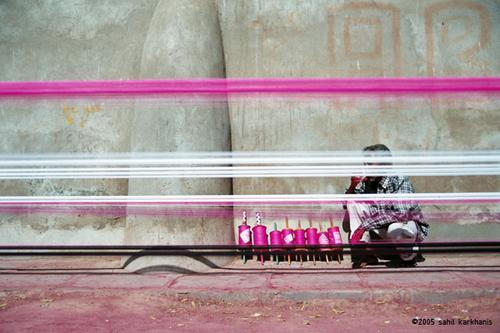
And the cycle starts over again...

_____

Nikon F75, 28-110mm
Fuji 100 ISO
2005, Ahmedabad, India
Read more »

Sharded Thread (7/8)


After all the hard work, a well deserved rest... I`ll sit on my haunches and sip tea...

_____

Nikon F75, 28-110mm
Fuji 100 ISO
2005, Ahmedabad, India
Read more »

Sharded Thread (6/8)


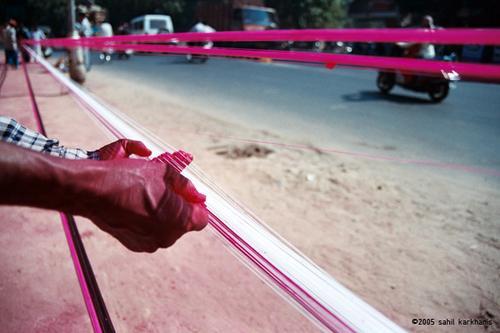
Spooling it all in... All that pristine-white yarn transformed by dint of hard work into fuschia coloured glass-shard coated lethal `manja` needs to be spooled on to wooden, metal or, increasingly nowadays, tacky-plastic `firkis` before it can be sold... The colourful firkis serve as point-of-purchase and product rolled into one... It`s a sight to see, all that colour by the roadside...

But these rag-covered, cut and bruised hands tell the real story behind the `manja`... And tell it only too well, I think...

_____

Nikon F75, 28-110mm
Fuji 100 ISO
2005, Ahmedabad, India
Read more »

Sharded Thread (5/8)


The process of dyeing the yards and yards of stretched out yarn is probably the most demanding. Coloured dye, organic glue (usually made from rice water) and glass shards are all mixed together as a paste. The bright fuschia colour is ample warning to everyone that handling the material can be potentially dangerous; the glass shards are lethal!

These pair of hands shown here have been hardened through weeks of handling the lethal paste. These people are usually too poor to afford protective gloves or suchlike. Some of them do have rags of old cloth wrapped around their `dyeing` hand to afford some protection, but most of them just live with the cuts and bruises as professional hazards...

_____

Nikon F75, 28-110mm
Fuji 100 ISO
2005, Ahmedabad, India
Read more »

Sharded Thread (4/8)


It never ceases to amaze me how surprisingly organised even some of the more unorganised sectors of the industry can be; with clearly defined heirarchy and job profile!

This man, for instance, supervises the entire yarn-stretching process. After the young kid is done walking between the posts laying out the yarn, it`s upto this man to ensure it`s been done right; that the threads are evenly spaced out on the holdfasts and that the yarn is neither too taut or too slack. Only when he`s completely satisfied does the actual dyeing process begin!

_____

Nikon F75, 28-110mm
Fuji 100 ISO
2005, Ahmedabad, India
Read more »

Sharded Thread (3/8)


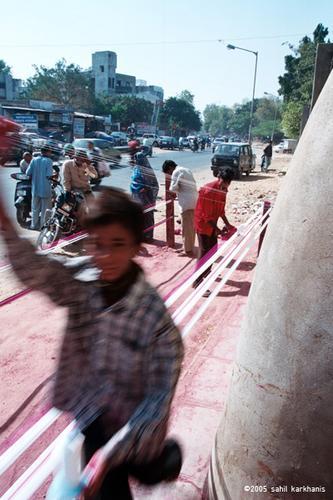
Stretching yarn might seem like childs play, but this young lad walks close to 10 kilometers on an average working day stretching the white yarn between the two wooden posts. He works from seven in the morning till about sundown and earns about Rs.50 (a little over a dollar) for all that...

_____

Nikon F75, 28-110mm
Fuji 100 ISO
2005, Ahmedabad, India
Read more »

Sharded Thread (2/8)


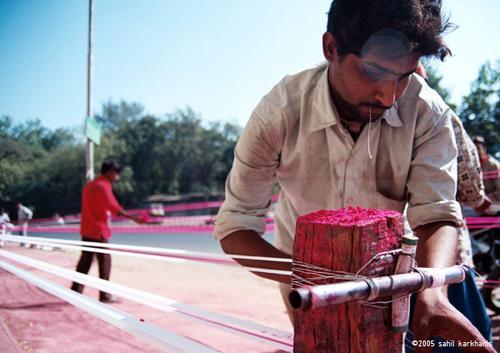
White yarn must first be carefully stretched out, each strand carefully spaced away from the other, so that the dyeing is even and fast. Makeshift wooden posts, stuck into the dusty roadside, serve as cheap and efficient fixtures on which to stretch the yarn. Metal pipes, rods, anything long and tubular tied or nailed onto the posts serve as holdfasts so that the yarn doesn`t slip or sag during dyeing.

The gnarled wood adorned with bright coloured powder dye; the worn-smoothnes of the pipes; the twisted wires; the stark white yarn and the well worked hands of the person plying the yarn makes for an interesting combination of textures..!

_____

Nikon F75, 28-110mm
Fuji 100 ISO
2005, Ahmedabad, India
Read more »

Sharded Thread (1/8)


Uttarayan is the festival of kites, celebrated in early January throughout India (under various names, depending on the region) to celebrate the change of season. Winter gives way to spring, the direction of the wind changes and suddenly the sky is awash with kites.

This colourful time of the year is a favourite for photographers who want to capture the ebulient spirit and the joi de vivre of Uttarayan. I have tried it on occasion in the past. The colourful, and fanciful, kites; the blaring music; clear blue skies and pleasant weather; people- old and new alike, wallowing in the fun that`s so intrinsic to the festival. It`s the perfect time of the year. This year, for a change, I thought it would be a good idea to document the saga of the manja- the sharded yarn that`s used to fly the kite, rather than the colourful kites or the mood of the moment.

I`d love to have your comments.

_____

Come Uttarayan and the roadsides are dotted with manja makers. Impromptu roadside set-ups to manufacture manja- the glass shard coated yarn that`s used to fly the kite. The mid-air duels between kite fliers is a sight worth watching with each trying to outfly the other- the winner is the kite that stays flying; the loser, the one with just a cut string in his hand, watching his kite floating away.

Bright coloured dye, glass shards, glue and, of course, yarn. The raw materials that go into making the spools and spools of manja that are consumed during this two day festival.

_____

Nikon F75, 28-110mm
Fuji 100 ISO
2005, Ahmedabad, India
Read more »

Flirting- In stone | Entry for Moody Monday- Sportive


[Edit]

Entry for Moody Monday
Sportive: Archaic. Amorous or wanton

[/Edit]

______

The step well at Patan, about 130 kilometers north of Ahmedabad, is known as Rani ki Vaav, or `The Queen`s Well`. It consists of a series of steps descending from ground level, in seven tiers, to a natural spring at the bottom.

The historic town of Patan served as the capital of the state of Gujarat for around 600 years, between the 8th and 14th centuries AD, under the Solanki kings. The step well at Patan served as the private bathing pool of Rani Udayamati, the consort of King Bhimadeva, the most illustrious of the Solanki kings.

The walls and pillars, all the way down to the seventh, and lowest, level are adorned with sculptures of gods, godesses and mythological characters from the Hindu pantheon. The coquettish Apsara (or celestial nymph) revelling in her vanity is a recurring motif in a lot of Hindu architecture of that period.

_____

Nikon F75, 28-110mm
Fuji 400 ISO
2004, Patan, North Gujarat, India
Read more »

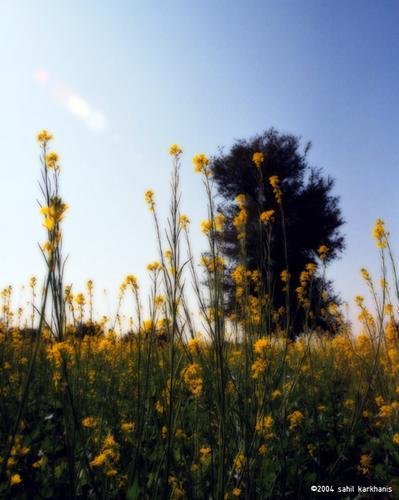
Mustard field


If you've ever been in a mustard field before you'll know that I took this picture despite an almost 100% chance of coming to greivous bodily harm... I'm talking about the honey bees, of course... ;)

_____

Nikon F75, 28-110mm
Fuji 100 ISO
2004, During a bike trip from Ahmedabad to Modhera, India
Read more »

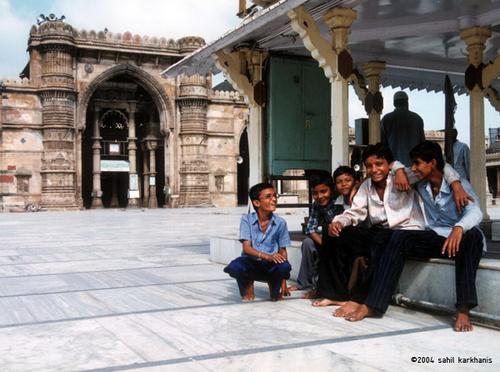
Afternoons off


The Jumma Masjid in Ahmedabad one balmy afternoon. These kids were playing cricket (believe it!) in the mosque, and quite enjoying themselves, until I took out my camera- then everyone wanted themselves photographed. No amount of cajoling could get them to resume their game and they just sat there posing to the camera, talking and laughing amongst themselves and I thought what the hell, here goes...

_____

Nikon F75, 28-110mm
Fuji 100 ISO
2004, Jumma Masjid, Ahmedabad, India
Read more »

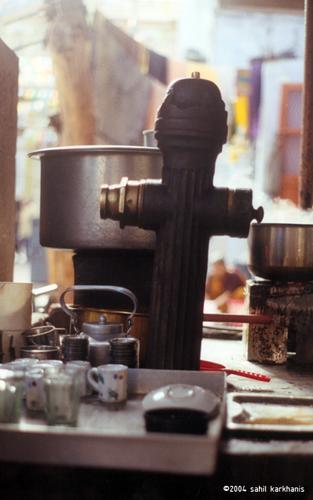
Chai shop and fire hydrant


Chai, or tea, is a socio-cultural phenomenon in India. 'Let's meet over a cuppa' has a whole different experience connected to it! Most villages, towns and even bustling megapolis' are dotted with roadside vendors selling a decidedly heady version of the brew involving, apart from the ubiquitous tea leves of course, milk and sugar and a host of spices- cardamom, cinnamon, cloves. More often than not these roadside stalls become popular socialising spots for college students and office goers alike.

The real estate scene being what it is, in India, business establishments vye for every available space, eventually taking what they get. But a chai shop around a fire hydrant is a first for me...!

_____

Pentax ME II Super, 50mm
Kodak 400 ISO
2004, Ahmedabad, India
Read more »

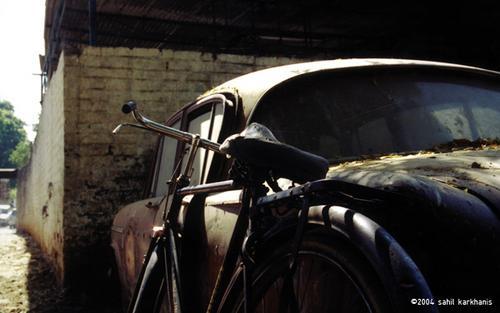
Can you...


...imagine us years from today?
Sharing a park bench quietly,
How terribly strange to be seventy.

Old friends
Memory brushes the same years,
Silently sharing the same fears...

_____

Nikon F75, 28-110mm
Fuji 100 ISO
2004, A roadside 'graveyard', Ahmedabad, India
Read more »

Light play


Some pictures don't need paragraphs written about them. Not because they're especially evocative or anything, but because they just are!

_____

Nikon F75, 28-110mm
Fuji 400 ISO
2004, Cafe Mint at Ahmedabad, India
Read more »

Night Market


Ahmedabad is a funny town. Or rather, two funny towns. You see, a river runs through it, effectively dividing the city into two halves- the older, more conservative half mostly inhabited by families and businesses that have been there for the last 300 years or so; and the newer, more upmarket half comprising a cosmopolitan demographic of people who've chosen to migrate here in the last 15-20 years or so.

The newer half purports to be hipper and more with it, looking down at the people from the other side of the river as the lesser half. It's funny it should be seen this way because, in my experience, the lesser half is where all the action is; albeit if you go for that kind of action, of course.

While the new town goes to bed around 10pm or so, the little alleyways on the other side of the river are choc-a-bloc with streetside vendors and road-revellers till the wee hours. This streetside meat stall, for example, was shot at midnight and in the background you might just pick up a barber's shop doing brisk business even then!

Me? I'm from the deader half. Go figure...

_____

Nikon F75, 28-110mm
Fuji 400 ISO
2004, Teen Darwaza, Ahmedabad, India
Read more »